Related Posts Widget for Blogs by LinkWithin


Rarely There

A collection of discourses - myriad, profound, uplifting...
Bah! Who am I kidding?!
It is just a blog.

Wednesday, June 10, 2015

Binge-Reading: Lee Child and Daniel Silva

Lee Child and Daniel Silva Jack reacher gabriel allon


It seems like every summer or thereabouts, I get into this binge-reading mode where every spare time is devoted to feverishly finishing one  novel after another till I am saturated for the time being.

The key is "spare time" - viz., time not spent working for bread-and-butter, cooking, cleaning, chauffeuring.

Anyway, of late, I've read one Jack Reacher novel after another, in no particular order. Starting with Personal, I went backwards a bit, and then decided to read them as and when I could get my hands on one.

Of course, commercial/pulp crime thriller is a sweeping label, but, there are well-written crime novels and there are poorly-written crime novels. Jack Reacher novels fall in the brilliantly-paced always-a-can't-put-me-down category for me.

I was skeptical when I picked up Personal on a whim. It was on my To Read list since its release early this year, along with other Jack Reacher novels.

I am not for scouring the Best Sellers list often and reading them all within 3 months of release date and discussing it avidly among fellow fans and such. I'll read the books at my own pace and at my own time of choosing, when my lifestyle allows such luxuries on and off.

And cosmically, the binge-reading bug bit me at the same time that Personal showed up in Parent Book Exchange shelf at my kids' school a few weeks ago. I snatched it up for my "car book" right then.

I have a book in my lunch bag, "the lunch book" (which currently is Hook's Revenge by Heidi Schulz), to read at lunch time in the lunch room at work. I have another in the car, "the car book", when I am waiting in the car to pick up the kids and chauffeur them as needed (which currently is A Wanted Man by Lee Child). Another book nestles in my backpack, "the bag book" (which for a few weeks has been Forget Me Not by Fern Michaels, with slow progress). Plus about 3 or 4 sit on my nightstand (which happen to be  Jack Reacher and Gabriel Allon books for now.)

On any given day, there may be 2 or 3 books that I am "currently reading"...

Over the last 3 weeks, I've managed to read a few Jack Reacher Novels.
I remember feeling a certain strong and favorable emotion for Jason Bourne back in my youth when I read them with starry eyes. After a long time, I can admit to feeling the same strong and favorable emotion for Jack Reacher now.

While some Reacher novels are in first person, I like the omniscient third person narratives better. Through Reacher's lines, we start shaping an image of him that fits our requirements. One might object to the overtly technical elements in physical confrontations that the author, Lee Child, tends to throw out frequently, but, it is relevant and sophisticated nevertheless, and it establishes Reacher's pedantic nature and his precise actions.

I also managed to read a bunch of Daniel Silva. The two older Michael Osborne novels - The Mark of the Assassin and The Marching Season - appealed to me a bit more than the later Gabriel Allon ones. I've read the first four of Gabriel Allon, plus The Messenger. And so far, Allon is not evoking the same strong and positive emotion that Jack Reacher is evoking in me, that Jason Bourne originally fired up in me.

Silva's book are intelligent and well-researched, with just enough of the improbable to keep it interesting. Not quite as intense as a Dan Brown but certainly not as boorish as a James Patterson either. However, Silva's books could use some tight editing, and a change in the narrator's tone that doesn't come across as pompous and high-handed -- it gets rather tedious and meandering at times, leading off in paths that have no relevance to how the plot ties up in the end.

I used to devour Robert Ludlum, Alistair MacLean, John le Carre, Frederick Forsythe in my youth. While crime thriller, espionage, and mystery are not my top genre anymore, I have constantly read a fair share of them over the years only to be saddened by the deteriorating standards in presentation and the formulaic plot points.

For now, I am all set for a few more weeks with Reacher and Allon, and they all promise to be a satisfying read.


Labels: , ,


Sunday, May 24, 2015

Plugged and Screwed


plugged eoin colfer book review

Plugged: A Novel,
Screwed: A Novel
by Eoin Colfer


After being introduced to the wry style, colorful characters, and an intricate yet fulfilling story in the Artemis Fowl series, I was curious about Colfer's novel for adults. I wasn't disappointed.

Plugged introduces Daniel McEvoy, a disenchanted ex-military Irish guy working as a bouncer in a sleazy New Jersey club. While not instantaneously charismatic, Daniel grew on me as the story unfolded. His heart is in the right place, he is rugged and resourceful, and he happens to be lucky as well, else there would be no story to tell.

A strange concatenation of circumstances takes Daniel from tragedy to calamity to disaster to near-annihilation. Being the main character, we know he'll survive somehow. At least, we hope he will, as the story is told in his flippant voice.

Clearly, Plugged isn't anything like Artemis Fowl as it is not a Young Adult fantasy but an adult crime thriller. However, it is anything but predictable. Though contrived, the plot is tight and unfolds at a rapid pace that kept me frantically flipping the pages in anticipation.

I used to devour Robert Ludlum, Alistair MacLean, John le Carre, Frederick Forsythe in my youth. While crime thriller, espionage, and mystery are not my top genre anymore, I have constantly read a fair share of them over the years to notice the deteriorating standards in presentation and the formulaic plot points. The more recent James Patterson books co-authored with others comes to mind as the prime example of disappointing novels. Women's Murder Club books were difficult to read. Somehow tedious repetition is supposed to project urgency and direness of the situation when all it ends up being is annoying. But, I am digressing...

The pleasures of reading any genre for me lies in the language nuances and style of narration. Most crime thrillers are fairly predictable - the hero is invincible/lucky/resourceful etc., the villain is devious/evil/equally resourceful etc. The circumstances arrange themselves to allow for plenty of action, and our protagonist and antagonist are physically supreme and well-matched, and possibly mentally as well. And yet, some of us keep going back to the same authors and protagonists wanting more because of the immense reading pleasure we derive.

The irreverent comedic undertones along with Daniel's sardonic wisecracks add to the reading experience. Early on in the book, we learn that Daniel has recently received hair plugs/implants as he is self-conscious about his receding hairline. And then, we encounter a disembodied sidekick Zeb, the "doctor" who performed the hair transplant, who talks in Daniels' head, thus adding a bit of zest to Daniel's monologues.

The subtle nod to erstwhile master of the espionage genre brought a smile: "I am surprised. ‘A disk? A bloody disk. What do I look like to you? Jason goddamn Bourne?”

Early on, in chapter 2, as Daniel slowly unfolds his personality for us, it was perfectly amusing when he asks: "A hair-obsessed ex-army doorman. What are the odds of those Venn diagram bubbles intersecting?"

It is these little nuggets that kept me reading on in furious pace. Of course, there's the usual drug turf war, murder, mayhem, ruthless mob boss and other such typical elements to keep the story moving, but, it is how Daniel moves through these elements that makes it worthwhile.

The sequel, Screwed, is equally cheeky and endearing at the same time.


Labels: , ,


Sunday, October 12, 2014

Heroes of Olympus


After zipping through Percy Jackson and the Olympians series four years ago, I knew that if Percy and Annabeth return for another quest, I must find out how it went.

So, when Blood of Olympus was finally released, I was ready to get my hands on all five books at once and read them back to back. And, circumstances so arranged themselves that I was ill one Friday and was curled up in bed. But, I was patting myself and smiling smugly as I had just picked up the first four books from the library. The fifth one, being a recent release, was in high demand and my place was 97th of 130 holds on 8 copies or something impossible like that.

Anyway, that's how I managed to finish all four books by that weekend, just recovering in bed, and escaping into the demigod world.

The books have all the right elements to make them a rollicking fun read. Non-stop action, one thing after another, impossible odds that our favorite demigods mange to beat... all with light-hearted exchanges and quick-thinking under duress. Hints are tucked in here and there, and the picture unfolds bit by bit... I could easily see my 9 year old willingly entering Percy and Annabeth's world and staying there, much like she wanted to with Harry Potter and Hermione.

As I've already mentioned my main discomfort and objection to the demigod adventures in the Percy Jackson post, I am copying and pasting the same here, as it applies in triple-fold to this series.

Being a jaded adult, I naturally shake my head and roll my eyes when the movie hero artfully dodges the bullets from multiple machine guns fired by the demented assailants and somehow manages to target every single one of these machine-gun-toting assailants with a mere pistol and triumph in the end.
Something about stacking up the odds against the hero completely disproportionately, only to make his victory seem all the more meritorious irks my senses.
However, that does not stop me from getting entangled in a well-spun yarn.

Giants abound, huge and menacing, and yet our tiny demigods manage to thwart them somehow. Especially the fourth book, House of Hades, set in Tartarus, with Tartarus rising towards the end, and the giant Bob along with a tiny cat aids Percy strategically, seemed completely unbelievable. I felt almost as if I was reading a screenplay written explicitly for action-oriented colossal CGI effects. 

At every tough spot, it seems like our favorite demigods summon the last of their strength, exhausted beyond recovery, to avoid certain death, only to find that a few minutes later they again summon the last of their strength to avert another major disaster that could end the whole world... It is nice to have a tight deadline to keep things moving, but right in the first book, The Lost Hero, the three demigods Jason, Leo, and Piper, manage to go all over the country and get bashed up and lost and betrayed and chased and hunted and blackmailed and defeat the giant and save Piper's father, all in 3 days' time.

One other thing that irked me was this deliberate twisting of mythological characters just for the shock effect. Like, Heracles/Hercules is a pompous, deluded jerk in this story. We already read about Dionysus in the original series and we learnt to accept him as the character had some novelty then.

Having said that I am a jaded adult, I must also admit that I look for enough internal consistency for the story to resonate with my young-adult heart. As an academic pursuit, I cannot but wonder at the author's immense energy and talent to write five 500+ page stories that make the kids want to read. Over and over sometimes. 

I like how the narration switches between the main demigods and we learn about them as we follow along their adventures. I like the peppering of Greek and Roman elements in this series. I like the irreverence and the heart-warming aspects inter-playing to a perfect balance. 

I like that it was not all about Percy and Annabeth, and in fact, Percy is overshadowed by Jason and Frank and Hazel and Piper and Leo, five of the most wonderful characters kids can relate to; plus Reyna and Hylla come across as strong and courageous. I did not want to put the book down till I knew everybody was safe, for now, until things started going haywire at the next turn...

And the best part for me? Having my 9 year old pick it up voluntarily and read it feverishly and discuss it with me, completely defending the book and dismissing any objections or inconsistencies I bring up. Of course, Mist will take care of stuff like that. Of course, you are not a demigod so you can't know how well they can do what they do... Of course, you are thinking like a human mommy...

Labels: , ,


Sunday, June 8, 2014

Luka and the Fire of Life, Boy, Snow, Bird, and Whisper

Of the half a dozen fiction over the last few months, these three were the most enjoyable read.


Luka and the Fire of Life
by Salman Rushdie

Having read and re-read Haroun and the Sea of Stories over the last two decades, I couldn't skip Luka and the Fire of Life. So, after the frenzy surrounding its launch died down, I quietly picked this up and relished the story-telling.

An inadvertent curse sets things in motion and the story progresses rapidly with a lot of action, a la video games, full of imagination and fantasy that only a master can relate with such deceptive simplicity.

There is a beauty in All's Well That End Well endings that is hard to ignore. The feeling that some books generate where you don't want to leave the magical world and return to your own reality is something truly special.


Boy, Snow, Bird
by Helen Oyeyemi

Brilliant writing. Superb crafting. Oyeyemi is a delight to read. After Mr.Fox, I was looking forward to more of Oyeyemi. And this book just perfectly fit the need. If I could, I'd quote about 70% of the book, but am indulging myself just a few - the passages that make one wonder if the author just thinks in those words or crafts it with precision, chiseling and honing till the brilliant sentences remains with us forever.

"... it's not whiteness itself that sets Them against Us, but the worship of whiteness. Same goes if you swap whiteness out for other things-- fancy possessions for sure, pedigree, maybe youth too... we beat Them (and spare ourselves a lot of tedium and terror) by declining to worship."

"But the shrieking went on and on, primal, almost glad—this protest was righteous. I couldn’t make up my mind whether the baby was male or female; the only certainties were near baldness and incandescent rage. The kid didn’t like its blanket, or its rattle, or the lap it was sat on, or the world . . . the time had come to demand quality."

"It was one of those ones they call screwball comedies, where people mislead and ill-treat each other in the most shocking and baffling way possible, then forgive and forget about it because they happen to like the look of each other. Only they call it falling in love."

"School is one long illness with symptoms that switch every five minutes so you think it's getting better or worse. But really it's the same thing for years and years."

Though the ending felt rushed and apologetic, the mingling of the magical fantasy with the very real social issues as well as the ever-confounding family quirks makes this quite a page-turner.


Whisper

by Christina Struyk-Bonn

Not another dystopian tale set in some indeterminate time period. This is happening in our world in some form. In a society that abandons such rejects - viz., babies born with deformities, hope can be hard to come by.

Whisper is born with a cleft palate, correctable, and yet she is abandoned by her family. Still loved by her mother, Whisper spends the first few years of her life accepting her situation, not thinking beyond what she faces each day.

As we follow Whisper's life, we wonder how many kids around the world are experiencing similar fate at this very minute. Things turn out fine for Whisper because she has a talent - her music is sublime. But what about the many who have nothing special to bank on for hope and salvation?


[image source: amazon.com]

Labels: ,


Sunday, January 5, 2014

Lilian Jackson Braun and The Cat... books with Qwilleran


Lilian Jackson braun The Cat Who books Qwilleran

Quite by accident, I came upon a pile of Lilian Jackson Braun's books and loved the first one I picked up at random, The Cat Who Went Into The Closet (15th book in the series).

It is no secret that I love cats. And, with prescient Siamese Koko and Yum Yum, Ms. Braun has hooked in the cat lovers with ease.

James MacIntosh Qwilleran is a fine character developed from a recovering alcoholic to a prim and proper newspaper columnist who just happens to be a millionaire, thanks to an inheritance which he diverts sensibly for charitable causes, mostly anonymously.

Qwilleran aka Qwill and his intuitive Siamese cats, Yum Yum and Koko, investigate odd incidents near and far in Moose County, "400 miles north of everywhere."

The books can be loosely termed as mysteries, but some are rather meandering and dull. However, the writing is never dull. The daily life of this quiet place and the nice people seem to be plagued by unsavory criminal incidents which Qwill, as an amateur sleuth, tries to solve.

Of course, Koko and Yum Yum are the real solvers - they turn up clues and evidence, without which Qwill can't dream of closing up the case. Along the way, cat lovers are treated to the comfortable pleasures of detailed descriptions of typical cat behavior that endears them to the said cat lovers.

I found only a handful to be true mysteries worth investigating; and the solution seemed pretty droll, sometimes rather far-fetched. But, Moose County and Pickax seems like a place I'd like to spend a quiet retirement vacation, preferably in summer.

Next on my list to read:  “The Cat Who Killed Lilian Jackson Braun” by Robert Kaplow.

Labels: ,


Sunday, November 10, 2013

Sita's Ramayana

Sita's Ramayana
text by Samhita Arni
art by Moyna Chitrakar


I was bowled over by Mahabharata - A Child's View by Samhita Arni. She was just eight when she wrote it. And illustrated it.

Having read many versions of the epic through the years, by various scholars, in English, as well as the miscellaneous abridged and interpreted versions in my mother tongue, I have a special fondness for this tale. Bhagavad Gita, which forms a part of this tome, has been a huge influence in my formative years.

The other famous epic tale from India, The Ramayana, has always taken second place in my hierarchy of beloved ancient tales, right from childhood. I did not like the way Sita was treated. I did not like the way Raamaa used trickery to help Sugriva. I did not like the wasteful war and death over a woman who simply wanted to live her life. Again, having read various versions of it in a couple of languages, not to mention the distilled child-size doses in picture books and Amar Chitra Katha graphic books, it was something I took for granted.

But, when I came across Sita's Ramayana, I loved it! It is a graphic novel where the illustrations take the center stage, with crisp minimal text. The story is told from Sita's point of view - the main female character in the story who has often been sidelined in other presentations.

It is a quick read, if one excludes the time spent in poring over the gorgeous pictures. But, well-told from Sita's perspective - what she probably knew, what she saw, what she felt, what she suffered. Finally, Sita simply retires into the womb of her mother - Mother Earth - unable to take the callous treatment of her by her husband, the impeccable Raamaa.

"Chandrabati Ramayana"/"Molla Ramayanamu" pioneered by two 16th Century women poets took this unique perspective of retelling the tale from Sita's point of view. Possibly deemed a "feminist Ramayana", it is easily ignored or condemned. I am yet to read their translated versions as I am not proficient in the languages they were written in - viz., Bengali/Telugu respectively.

[image source: Author Samhita Arni's website]

Labels: , ,


Sunday, October 13, 2013

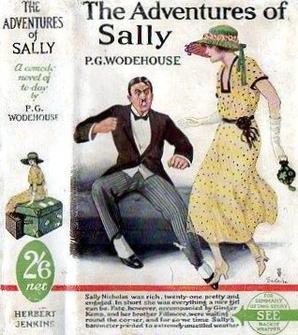
The Adventures of Sally

The Adventures of Sally
By P.G. Wodehouse


It seems silly for me to write about P.G.Wodehouse's books here. Although inherently averse to fanaticism, I have held PGW's books in very high esteem practically from teenage when I first encountered them. They are a class apart.

If I were forced to pick one writer as my favorite, I would easily choose TP&PGW - opting to club them together as one entity (TP = Terry Pratchett). Only because they both inspire me immensely.

Well, enough of this gushing.

Moving on, The Adventures of Sally is not about Jeeves or Blandings Castle or Uncle Fred or any of the more popular staples associated with PGW. Nevertheless, it is a brilliantly written story, with the characteristic twists and turns and entanglements, all ending to everyone's satisfaction.

What's amazing about both PGW &TP is that they are keen observers of human nature, and they unfold the emotions behind the actions in a brilliant yet stark way that leaves us keeling over with fits of laughter. And they both know how to tell a tale - seemingly innocuous, yet profoundly complex.

Enough said.

I just wanted to list this book here as it is a hugely satisfying read, over and over.

[image source: Wikipedia]

Labels: , ,


Wednesday, July 24, 2013

Detective,Mystery,Crime Binge


I've been on this binge-of-sorts lately - of detective/mystery/action/legal/crime/suspense type paperbacks.  Nelson DeMille, John Grisham, Daniel Silva, James Patterson et al.

I've been reading them without rhyme or reason - just whatever I can get my hands on - Run For Your Life, The Associate, The Last Juror, The Messenger, Plum Island, The Lion's Game... and, often, not waiting to complete one before starting the next novel.

Most days I switch between 2 or even 3 books I am "currently reading"... Easier to do as I have one book in the car, one in my backpack, two or three on my night stand so wherever I happen to be, I have a book handy to read.

Of course, even in this genre, there are some really well-written books with attention to language and plot and characters just as there are some quick cheap thrillers. Nelson DeMille's John Corey vs. Daniel Silva's Gabriel Allon vs. James Patterson's Michael Bennett... International Terrorist vs. Domestic Psychopath... it's all in the game. Just light reading.

And then, I've been re-reading some of the traditional classics of the detective mystery genre - Agatha Christie, Sherlock Holmes, P.D.James, John le Carré.

Though nothing much about these books inspired me to write a detailed post here, they satisfied a certain craving nevertheless.


Labels: , ,


Monday, May 20, 2013

My Sherlock Holmes: Untold Stories of the Great Detective


My Sherlock Holmes: Untold Stories of the Great Detective

My Sherlock Holmes: Untold Stories of the Great Detective
 edited by Michael Kurland
stories by Barbara Hambly, Michael Mallory, Norman Schreiber, Peter Tremayne, Mel, GIlden, Richard Lupoff and others


The anthology of 13 stories contributed by various authors about one of my favorite literary characters seemed promising, especially since the stories are narrated from the perspective of some of the secondary characters, not Dr.Watson's; and, edited by Michael Kurland whose other Holmes books had a diametrically opposite perspective that it made me sit up and explore the possibility.

I decided to read the stories in this book in no particular order.

A handful turned out to be quite interesting and impressive, some were rather insipid, and a few were quite uncharacteristic and lacked respect for Sir Arthur Conan Doyle's stalwart detective. But they all projected the spirit of the times in the style reminiscent of Holmes' original adventures.

"Call me Wiggins" was one of the stories I enjoyed. The young urchin, the Baker Street Irregular Wiggins, that Holmes employs as his eyes and ears in the streets often, is apparently taken under the great detective's wing, educated and trained, and even allowed to solve a case, on his own, successfully at that. Lewis Carroll's private life dragged into this story was a bit distasteful but the narration was quite tight and consistent.

"The Adventure of the Forgotten Umbrella", "The Riddle of the Young Protestor", "Mrs.Hudson Reminiscences", "And the Others", "Mycroft's Great Game" were all quite enjoyable. Couldn't say that for some of the other stories.

However, having tremendous respect for writers, especially ones who can take a famous character and write in a different voice, a different perspective, and still maintain authenticity and integrity, I did enjoy reading this book. I am no armchair literary critic - I prefer to share the books I enjoyed and not invest time in writing about the ones I didn't.

There were no apologies or excuses given for Sherlock Holmes in Doyle's narration - he is who he is. I liked that. Despite the coke addiction, despite the brusque and supercilious nature, Holmes had a certain sense of justice even if he had little regard for the law. As a result, I think I am biased against perspectives that try to make him appear amiable and even congenial, or for that matter tyrannical and vindictive.

As long as they keep publishing such collections, I think I will keep reading them.


Labels: , ,


Sunday, November 18, 2012

Dodger

Dodger
by Terry Pratchett

Pratchett's 50th novel, Dodger, is set not in the fantastical Discworld but in Victorian London with its nobs and downtrodden, heroines and villains, not to mention Benjamin Disraeli (PM of GB), Sir Joseph Bazalgette (Sewer Network Engineer), Henry Mayhew (social researcher and co-founder of Punch magazine), Sir Robert Peel (Metropolitan Police), and Charles Dickens himself.

The story is rather straightforward and predictable - young Dodger,a street urchin, can do no wrong despite living in the slums, orphaned, and resorting to thieving, and finally settling for rummaging in the sewers for 'lost' objects of value. He has the necessary skills to survive, has the beautiful heart to be generous, plus has a mandatory mentor who shares his living quarters with his dog Onan and the enigmatic Dodger . (If the dog's name is curious, the author urges us to 'google it').

Young Ms. Simplicity escapes from a loveless and abusive marriage to a rich and powerful European but is tracked and beaten up in London, somewhere near Dodger's usual haunt. Gallant and quick as he is, he saves the lady, who is then escorted by Henry Mayhew to his own home where his wife cares for such 'cases'.

Dodger grows very fond of Ms.Simplicity, who reciprocates in kind. Ms. Simplicity is not just any girl, a runaway - politics is involved, wars can start if she is not returned to her lawful husband. But, is it right to send her back to die?

Enter 'Charlie' Charles Dickens, with whose help Dodger quickly climbs up the social ladder, thanks to Ms. Burdett-Coutts and the right concatenation of events. It seems Dodger is favored by The Lady (of the Sewers) as well.

After a slightly tough start (for me, reading-wise), Pratchett's characteristic wit takes over and the story unfolds with the usual humor and twists that make it such a pleasure. The confusing contradictions of the Victorian England - women's place in society, the class distinction, the tenuous relationships between countries... all make for an interesting backdrop for the story.

Solomon, Dodger's mentor and landlord, is full of wisdom, dropping gems at the right moment, hinting at his exotic and checkered past just enough to preserve the air of mystery.

All's well that ends well. Boy gets the girl, villains are thwarted and justice prevails, sort of.

[image source: http://terrypratchett.co.uk/index.php/us/books/dodger]

Labels: , ,


Monday, September 10, 2012

Snuff


Snuff
by Terry Pratchett


I admire Terry Pratchett not just for the side-splittingly funny story-telling he consistently offers but also for his thoughtful and deep social observations and commentaries.

While typically billed for Young Adult, I doubt if many of his books (Small Gods, Carpe Jugulum, Night Watch, Monstrous Regiment, The Truth, Thud!, Thief of Time, to name a few) would be fully appreciated by the tender minds as yet inexperienced and therefore potentially unaware of the significance and overtones of the narration.

As Siddhartha said, Knowledge can be communicated but Wisdom cannot. And sometimes, with age (and experience) comes wisdom, which allows for a greater appreciation of Pratchett's insightful genius.

All right, enough with the expounding, on with the book at hand...

Snuff is a Commander Vimes mystery. That's it in a nutshell, but, that hardly does justice to the 400-odd pages of sheer adventure.

Of the many wonderful characters who grace the Discworld, Commander Vimes grew in stature with the many books, from a lowly copper in the Night Watch to Captain to now the Commander of the bulging Watch, not to mention being His Grace the Duke of Ankh-Morpork.

Snuff addresses the social issue of racial discrimination head-on, albeit in its inimitable parallel world which is no different from the world we live in, except of course for the flatness of the Disc and the elephants carrying it riding on the giant turtle, the Great A'Tuin, and suchlike.

Goblins have never been admired much in literature so far, tending to be depicted as lowly, filthy, scums, probably sharp and cunning, but not the ones you want to acknowledge the existence of, let alone befriend or even associate with.

In Snuff, Pratchett introduces us to goblins in much the same way - rather unappealing to look at, with the strange habit of collecting their bodily fluids in a pot and carrying it around with them at all times. Shunned by 'normal' folks, driven to live in hiding, with a status way below wretched animals in their society, goblins do not elicit much from us but disgust at the beginning.

As the story unfolds, so does Pratchett's propensity for peeling the layers of filters we wear to deny such sights that should morally disturb us.

We end up championing for the goblins, one of whom is inducted into the Watch, and all of whom seem to come across with some innate quality worth recognizing, if not appreciating.

There are several elements to this story which all come together in the end, beautifully as always:
Lady Sybill's impressive influence on His Grace Sir Samuel Vimes' life;
the delicate dance of marriage; the sense of duty that Vimes cannot seem to shut off;
the dynamics of fatherhood (young master Sam Vimes' interest in bowel movements of living creatures might be a tad uncomfortable for some, but, with two young ones myself who get excited finding dog poo during our walks I did catch myself smiling inwardly at the masterly touch);
the complexities of the hierarchical society; the (in)cohesiveness of the Watch at times;
Vimes' brilliant detective work and his ability to think on his feet;
oh, and as the title suggests, there is 'snuff' involved, of the tobacco kind that is entangled in a smuggling racket...

Plot thickens, as they say, and events concatenate to a very satisfying climax.

One of the more serious and dark books of Pratchett, Snuff is probably not for the early teenager. It is a fast-paced read which does tend to meander at times.

While it might seem like a simple murder mystery with a few intertwined criminal threads, Snuff is much more than just that.

[An interview with Terry Pratchett by Neil Gaiman at Amazon.com]

[image source: terrypratchett.co.uk]

Labels: , ,


Friday, July 6, 2012

I Shall Wear Midnight

I Shall Wear Midnight
by Terry Pratchett

After Wee Free Men, A Hat Full of Sky, and Wintersmith, we meet Tiffany Aching yet again as a 16 year old practicing witch, doing the needful for the needy, nothing glamorous, nothing fanciful, just back-breaking work that touches people's lives in a way that only witches care to do. She is the hag o' the hills. Chalk's very own witch.

But then, witches are suddenly becoming unpopular. Not that they were popular to begin with - they were ignored and perhaps feared, but they were duly acknowledged and accepted, they were respected. Not anymore. A whisper, a thought, a feeling rears up and the witches are condemned and scorned, hated and hunted.


Traditionally witches wore black. Tiffany preferred green. They also wore pointy hats. Tiffany was going to make her own hat. The title refers to something Tiffany says in A Hat Full of Sky, ""When I'm old I shall wear midnight, she'd decided. But for now she'd had enough of darkness." 


I was terribly torn as I read the book - none of the usual buoyant humor and witty social commentary that I've come to love Pratchett for. This book is dark with a rather meandering story arc, with some unappealing and one-dimensional characters. 


The brilliance of Pratchett's writing, his ability to string the words into a perfectly fabricated sentence that delivers the punch while being side-splitting-ly funny and instructive, is what I treasure more than just the plot and the characters and the clever narration. 


I Shall Wear Midnight is sadly not one of those books that I shall treasure for the sheer joy of reading. And it breaks my heart to admit it, because, clearly, Pratchett is losing his battle with early-onset Alzheimer's and the world is losing a genius. 


But then Pratchett's worst is still better than others' best. And this is not a book to be tossed aside lightly. Pratchett's keen observation and understanding of human workings comes through in piercing depth.


It was painful to start the book reading in detail about domestic violence and child abuse and murder and the ferocity of the lynch-mob and the poison of rumors and hatred. 


The characters were difficult to empathize or identify with. The Pettys, Letitia, the Duchess, Derek, even the eyeless villain, Cunning Man, were all rather distasteful, no redeeming features. Unfortunately, even my favorite Feegles suffer from this treatment - the impish, fiercely loyal, funny and riotous Feegles turn rather insufferable at times in this narration. 


The Watch meets Mistress Weatherwax meets Tiffany Aching story has so many possibilities. But, this book did not explore or present much in terms of appreciating the combination.


Having gotten that out of my chest, I must add that there are layers of subtle commentaries on relationships and machinations of the world that are quite thought-provoking. While Tiffany's relationship with Roland ("we're good friends") is much talked about in Chalk, that romantic aspect is incidental to the story, yet masterfully explored. What do people expect of their witch?

Tiffany is not a normal teenager. But then, which teenager is really normal? Which teenager, witch or otherwise, doesn't wonder, Will anyone understand me? Will they know what I go through? Will they always treat me like an outsider? Will they not realize I am human?

I was able to finish this book in a day, thanks to July 4th holiday, but the book was not an easy read.

All's well that ends well. How Tiffany beats Cunning Man seems rather hastily stitched together, just to get it out of the way and done with. Tiffany advocates for social progress with a new school and maybe a medic for the village and so on, very noble, very thoughtful... and the new Baron, her good friend Roland, does indulge her wishes very kindly.


[image source: terrypratchett.co.uk]

Labels: , , ,


Wednesday, July 4, 2012

Wintersmith

Wintersmith
by Terry Pratchett

The third book in the Tiffany Aching series, Wintersmith is a delightful read, as always, narrating the story of what happened when almost-13-year-old Tiffany felt the urge to dance.

 Not any old dance, not an ordinary girlish frolic, easily indulged and without much consequence, with a village friend. No. She steps into the Summer Lady's spot where the Wintersmith has tangoed with her for eternity in the Dance of the Seasons.

I met Tiffany in Wee Free Men. At 9, she didn't like not being the youngest and didn't like having to babysit her brother, but, willingly  stepped into Fairyland armed with a frying pan to retrieve her brother from the Queen of the Fairies.

At 11, in A Hat Full of Sky, Tiffany's entry into witch-hood (witchdom?) was quite dramatic, thanks to the hiver that takes over her as it had taken over thousands before, only to destroy them in the end. Tiffany's successful apprenticeship and return to Chalk, her home, etched her in my mind.

And now, at 13, she has done it again. Only, she didn't know what she had done. Or how to undo it. Can Granny Weatherwax and the Nac Mac Feegles help her out once again before the world freezes over?

It is no secret that I keep going back to Pratchett's books for his writing. Out of context, and randomly quoted, his words may seem just bits of frivolous indulgence, possibly funny but not all that deep. However, when taken in with his wisdom and commentary on human nature, his words simply stagger my mind. I wonder, did he just set out to write that sentence as it is and just type it out? Or did he write down the idea, scratch and polish over time to get that perfectly shining sentence conveying exactly what it does at face-value but much more as the mind unfolds it in its unique way?


The summary of Wintersmith is simple: Tiffany makes the mistake of dancing with the Wintersmith who mistakes her for the Lady of Summer and is immediately smitten with her. He follows her with his iciness and freezes the world for her to be his. But when the wee lambs are dying of cold and the world feels doomed to chillness forever, Tiffany manages to take charge. She finds a way to reunite the Summer Lady and the Wintersmith and bring Spring back to the world. 


Tiffany, like any 13-year old, initially loves the attention from the Wintersmith, but her Third Thoughts tell her it is not right. Her Second Thoughts wonder why she likes the attention. Her First Sight sees little Tiffanys in the snowflakes and wonders if that is the worst thing that can happen to embarrass her. 


And what about Roland? Sure, she incidentally rescued him from the Queen of Fairies when she got her brother back, but, is he as dense as she had assumed? Does he hold a torch for her? If so, does she care? And if she does, will she do anything about it? Other than curtsy and make him nervous? 


We learn a lot more about Tiffany, the Feegles, their Kelda Jeannie, and the sorority of witches and how they keep a watch on each other. 


Rob Anybody, with Daft Wullie and the Feegles, are irrepressible and rather adorable. The Scots conversations are a treat to read, the characters forming clearly even as they are clumped together as a clan of little blue men who love to steal and drink and fight. 


Just because the protagonist is a young adult, the book itself is not just for the Young Adult. In fact, there are very few Pratchett books that I think the young adult would experience at a depth that age/experience/wisdom allows.
[image source: terrypratchett.co.uk]

Labels: , , ,


Tuesday, July 3, 2012

A Hat Full of Sky

A Hat Full of Sky
by Terry Pratchett

The second in the Tiffany Aching adventure, following The Wee Free Men, A Hat Full of Sky showcases this plucky young 11-year-old heroine's mettle as she embarks on her apprenticeship in magic.

Tiffany is a hard name for a witch to live down. But, in ancient tongue it also means Land Under Wave, something hard to live up to. But, Tiffany is up for it.

The Hiver, at once terrifying and curious, is a creature with no body, no real mind, but just a sort of parasite that holds the echoes of the memories it has taken over since before time began. The hiver seeks power more for its sustenance, for its existence at some level, than for some grand end. So, the hiver naturally finds Tiffany, a powerful young witch who does not know quite how powerful she is and why.

With Granny Weatherwax's and the Nac Mac Feegles' support, it would seem like Tiffany is well-armed, but, she must face the hiver alone, in her mind. And it will take all of her resource and courage to deal with it, perhaps more.

What struck me about this book is the pre-teen Tiffany's bundle of emotions portrayed expertly by the author, once again establishing his mastery over not just the nuances of the language but of the human emotions and social entanglements.

Arriving at Miss. Level's cottage, naive yet determined, Tiffany was most certainly not ready for the double Miss Levels - two bodies with one mind, but not in the traditional "twins" way. But she takes it in her stride and manages quite well despite the invisible neat-freak Oswald tidying up after her even before she is done messing up her room.

She has no friends yet; she is far away from Chalk, her home; she does not know what the apprenticeship involves; she hopes it will be all about learning to be a witch but is slowly finding out that it might not be all about the conventional abracadabra magic but of the more subtle sort; she is quick to form opinions but quick to change them when reason demands it;  and she is certainly sure of herself, at least until the hiver takes over her.

Will she turn "evil" and start to cackle? Because we all know that a witch is only one step away from cackling if nobody is keeping an eye on her and she forgets the difference between right and wrong and no longer feels the need to be accountable for her decisions.

All's well that ends well, as always in Pratchett's wonderful Discworld tales. Tiffany manages to send the hiver away to a place it cannot return from. She earns the respect of fellow young witches and the greatest witch of all, Granny Weatherwax, who is one of the most intriguing and complex characters in the Discworld.

Tiffany learns a lot about herself, about witching, and about making her own hat. Granny Aching wore the wind for her coat and Tiffany will wear the sky for her hat. She may not be able to fly the broom without getting sick or make a shamble in a hurry (unless she really needs to), but, she can certainly open the door and show the departed the way into the next world, just like that.

Pratchett's genius always leaves me awed and inspired. His keen observation and accessible presentation, not to mention his flair of language and the side-splitting-ly funny narration makes his books a much-savored experience every time I read one.

[image source: terrypratchett.co.uk]

Labels: , , ,


Sunday, June 24, 2012

The Illustrated Wee Free Men

The Illustrated Wee Free Men
by Terry Pratchett
illustrated by Stephen Player

In this first book in the Tiffany Aching series, Pratchett packs it with his usual touches - unforgettable characters, out-of-the-world situations, romping adventure, brilliant wit, plus his inimitable humor and perspective on social issues.

The Illustrated Wee Free Men is quite a visual experience. Be it the full page pictures that sort of form the background for the text superimposed on it, or the wee little Feegles hanging precariously off a letter or quietly trying to make off with one along the edges, or the shadows and typography lending the ambiance, the illustrations complement the text superbly, neither interfering nor distracting but in perfect harmony with the images the words manage to paint in our heads.

Tiffany Aching of the Chalk is all of 9 years old, but very practical and efficient at carrying out her duties, blessed with keen observation and strong intuition, not to mention her cheese-making talents, who never misses an opportunity to do some extra learning on the side whenever she can spare the extra carrot or the egg - the fee for gaining knowledge from traveling teachers.

A girl cannot know enough, especially if she is a witch. She is not thrilled about babysitting her little brother Wentworth as much as she has to, but, she does it nonetheless. "He's a nuisance! He takes up my time and I'm always having to look after him and he always wants sweets."

But when her brother is stolen, she will not say Good Riddance and get on with her life. No. She will go to the end of the world, into the dream world, muster all the strength, determination, knowledge and courage she can to bring him back home safely.

Thankfully for Tiffany, she doesn't have to do it alone. The 6-inch tall, blue-skinned, red-haired, kilt-wearing, Scots speaking Nac Mac Feegles always keep an eye out for her, their Wee Big Hag.

"Crivens! Gang awa' oot o' here, ye daft wee hinny! 'Ware the green heid!... Nae time for fishin'!"

With Rob Anybody, their Big Man o' the clan, Daft Wullie, William the gonnagle, Hamish the aviator and a lot more weird ones, the Feegles are easily the at-once-simple-yet-richly-complex characters encountered in Pratchett's menagerie. They are pictsies (not pixies, oh no)  full of vigor and the fighting spirit, as well as the alcoholic spirits which they imbibe in copious amounts whenever they can, stealing anything not nailed down, tending to scream 'Crivens!' and 'Oh Waily! Waily! Waily!' a lot, fiercely protective of Tiffany yet terrified of her wrath, jumping headlong into unknown situations and coming out fine in the end... if we end up loving them in the end knowing what a nuisance they can be it is thanks to Pratchett.

What can I say about Granny Aching? Well, other than what the story reveals, of course? Almost all the matronly women authority figures in Pratchett's books are awesome, some more authoritarian while others rather quietly compelling. Granny Weatherwax is an all-time favorite of mine, but close on her heels is Nanny Ogg, and now the no-longer-with-us Granny Aching, Tiffany's grandma.

It is quite a wild ride when Tiffany sets out into the dream world where Wentworth is trapped. She not only manages to get back Wentworth but also rescues the Baron's son, Roland, who was decomposing there unbeknownst to him.

All's well that ends well. It is indeed something when one finishes the book but the book is not finished with one. I caught myself going back to it, flipping to favorite pages and relishing the experience. Of course, I do that with all of Pratchett's books.


Although it is a suggested Young Adult novel, the book is a wonderful read for older readers. This is another of Pratchett's books that I would love to have on my bookshelf to pass on to my kids when they are ready for it. 

[image source: amazon.com]

Labels: , , ,


Tuesday, April 24, 2012

The Cheshire Cheese Cat

The Cheshire Cheese Cat
A Dickens of a Tale
by Carmen Agra Deedy & Randall Wright
illustrated by Barry Moser


Take the best cheese in England, a literate and resourceful mouse, a well-meaning solitary cat with a potentially shameful secret; and his nemesis of a savage feline beast plus a raving Tower raven; and add in some colorful human characters including our very own Mr.C. Dickens, the writer; and put them in an absurdly intricate yet easy-to-unravel situation, and you have the makings of a riotous story for pages to come.

Add to it the brilliance of English language and compound story-telling, and there is a sure winner.

Although this hilarious romp is marketed for the young adult around middle grade or thereabouts, I had such a fantastic laugh that I am convinced it is for all ages. Well, ages 8+ perhaps as the Dickensian tale with its wry humor and sophisticated patter would be lost on the beginner readers.

Better yet, I think it is best enjoyed by the discerning adult who can get the subtle references and chuckle heartily. But then, that's just a perk, an incidental frolic. The book stands on its own thanks to some exceptional writing and shrewd characterization.

Ye Olde Cheshire Inn makes the best cheese in all of England. Pip, the talking, reading, writing mouse manages to herd his motley pack lodging in this Inn, while ensuring plenty of the best cheese for their consumption.

Into this harmonious dwellings is introduced Skilley, fleet of foot, a cat among cats. Or so he would have been, but for a secret: his love for cheese. Skilley, even though he is ashamed to admit it, is a cheese-loving cat who cannot bring himself to catch, let alone eat, a mouse. But dares to present himself as a mouser at Ye Olde Cheshire Inn.

Pinch is the impending danger lurking around the corner: a perfectly foul villain who kills mice just for fun, and is Skilley's nemesis.

Maldwyn, a misunderstood raven kidnapped from the Tower of London, or so he believes.

There is no way I will be able to do justice to the style of language and characters and narration. It is not to be taken seriously, the book, I mean. How can I when one of the pages in the book is an entry from Dickens' journal that reads:

                 
                               C. Dickens


Those were dire days indeed.
The times were cruel
ghastly
appalling
It was the worst of all the days the world has seen-

Oh, why can't I write an opening for my new novel that stands out from all the rest?

...

I'm at Ye Olde Cheshire today with my friend Wilkie. I was looking forward to a marvelous afternoon of cheese and chummery, but with my well of words tapped dry, I can only despair.

...

I think I'll just jump in the Thames.
Or become a lamplighter or a chimney sweep.
Anything but a writer.


Of course, little ones may not get the reference to the Tale of Two Cities, but it doesn't take away from the story.

Chapter Ten has some creative type-setting like the ones in books with concrete poetry - the font style and arrangement makes it an enhanced reading experience.

The black-and-white illustrations capture the characters and moods perfectly, adding a bit of humor to it that is subtle yet forceful.

I can only imagine the kind of fun the authors must've had while writing this book.

All's well that ends well. There are a few knots in the proceedings which get straightened out to everyone's advantage in the end, with a surprise last minute entrance from a mysterious visitor who sorts things out as is expected of her.

This is a book I'd love to have in my bookshelf to reach for at will and read a few pages at random and know that I will be entertained and amused each time. I am adding it to the as-yet-non-existent Reading List for the kids when they are ready.

[image source: schoollibraryjournal.com]

Labels: ,


Thursday, June 16, 2011

Bourne Sanction, Bourne Deception

Bourne Sanction,
Bourne Deception,
by Eric Van Lustbader


No doubt many from my generation went through the Richard Bach phase quoting profusely from Illusions, saving a special place in their hearts (and bookshelves) for Jonathan Livingston Seagull.

When I was young and impressionable, and not so jaded, I fell in love with just about every dashing character in the novels I read. Like Jason Bourne, for instance. I could never get him out of my mind among all the two dozen Ludlum novels I read until the plot all began to get enmeshed, confounding my poor brain.

I refused to watch Matt Damon's Jason Bourne movies because I did not want to distort this perfect image of Bourne I had shaped in my teenage mind. Eventually, I did give in and watch, fighting and knocking it all the way through. I love Matt Damon. Totally. But, I liked the Jason Bourne my mind created more. Matt was just too cute to be Jason in my head. No matter.

Anyway, taking a popular character like Bourne, written by a master of the genre, and trying to present him to the same (and potentially new) audience is not easy. So, when I heard about the new Jason Bourne novels by Eric Van Lustbader, I scoffed thanks to my usual state of resistance to welcome change.

And then, I came around and read them. And, they are not too terrible. Considering how easily I get disenchanted these days, it has not been easy to stick with tedious and meandering prose and plot in action mystery thriller novels genre anymore.

Did I like the new Bourne books? Well, it depends on what we mean by "like".

I read it fast, it wasn't too time-consuming. It wasn't too painful. The prose was quite repetitive and blasé. The plot moved more at a leisurely freight train speed when I expected close to purposeful jetliner speed, if not warp-speed. But, that's just me. I'll stick with my original Jason Bourne until Ludlum decides to come back and breathe life into his enigmatic character, entangling him in believable yet convoluted plots, unfolding a fantastic story that I have to read holding my breath.

Labels: , ,


Sunday, March 13, 2011

The Hunger Games Trilogy


The Hunger Games,
Catching Fire,
Mockingjay
by Suzanne Collins

The Hunger Games has received rave reviews and justifiably so. It certainly is a page-turner, with interesting premise and memorable characters.

Even if quite gory (for the young adult at least), it seems to be within the expectations of what a fantasy-minded reader might accept, considering the new rules of survival in the new world.

Somewhere in the future man has totally obliterated all the wondrous things he made in his world. Panem is what survives this destruction, with isolated pockets of civilization struggling to stay alive with some sort of central power controlling their lives with an iron grip and callous heart.

Almost all fantasy fiction relies on an unlikely young hero/heroine who inadvertently rises to the challenge (whatever it may be), is favored by Destiny/Fate, manages to survive, and uphold truth, justice and what-not. Sometimes, the hero(ine) is not all that noble, not even well-equipped to deal with the devious adult minds, but they learn fast and adapt.

Katniss Everdeen is one such quick-learning survivor, even if terribly young and naive at the beginning. And we end up loving her as the book progresses, despite her sometimes-ambivalent nature, and her flippant attitude towards self-preservation. With a doll of a younger sister, and a barely-there mother who is struggling to cope with the loss of her husband, Katniss exhibits practical smarts by doing whatever it takes to keep her family alive.

There has to be some sort of triangle as far as emotional entanglements go, in order to add to the already confused heroine's list of woes. And that's where Peeta and Gale come in. A soothing, inherently nice son of a baker, and a cold, cynical hunter who bears the responsibility of feeding and keeping his family alive after his father's death.

The Hunger Games itself is a terrifying annual event that Suzanne Collins has set up in great detail. It is a cruel game with barely any rules, created, controlled, and manipulated by the Gamekeepers. And it is televised live (edited where suitable), with some parade and interviews and theatrics making it look like a carefully staged production of a reality show.

Two children from each of the 12 districts gather to fight for their lives, killing off the others in the process. Only one will be the victor in the end, alive and allowed to live the rest of his/her life out in relative peace.

Even that is not guaranteed, as Katniss and Peeta find out. Do they make it to the end? Does their love for each other help them stay rooted to what little reality they can perceive to stay sane enough to function? This is certainly not a romantic fantasy by any stretch.

All that poverty and misery in the district dwellers' lives makes it quite heart-wrenching, for, when we give up our freedoms slowly and willingly, before we know it, we have signed off our dignity and self-respect and most of all, courage.

There was something about the end, in the Mockingjay book, that seemed a little misplaced, abrupt, and contrived for me. It read like a movie script, which in itself is not bad, but, when half way through a movie we realize this must be the last reel as things are wrapping up, we find reel after reel of elaborate prolongation that seem to add little to the plot. But, that's just me.

One of the acceptable evils of fantasy is the fluid lines of morality. The hero/heroine has to uphold justice (or what they see as truth) and in order to do so, they have the license to maim, hurt, even kill as best as they can, for their own survival is at stake and that is what most beings are programmed to do: Self-defense.

The first two books in the trilogy focused on the games, the characters, their survival. But the third book shifts gears to reveal Katniss has been a pawn in a much larger scheme that power-mongers played without mercy or remorse. Mockingjay also explored the severe psychological effects on the survivors of the Hunger Games.

Stacking up the odds against the hero(ine) impossibly high and then managing to somehow extricate them from hopeless situations is possibly overdone, but that is also what makes some of the characters memorable in the fantasy fiction. Not because they have some special powers, but because they use what they have to do what it takes.

All in all, very entertaining; somewhat thought-provoking, as it is possible that humanity could end up self-destructing on purpose; and very readable.


[image source: www.wired.com]

Labels: , ,


Monday, January 24, 2011

Unseen Academicals


Unseen Academicals
by Terry Pratchett

Take Football, Soccer if you will, although I prefer Football.

No, not the game per se. The insanity the game births and nurses and fosters.

That's the subject of Pratchett's genial attack in this 37th book in the Discworld Series.

Unseen Academicals are the wizards of the Unseen University (UU), led by none other than Mustrum Ridcully, (with the Librarian for their goalie), who have to win a football game playing by the rules (even if they make up the rules themselves) and using no magic. Else they lose a big chunk of endowment for the University. Or so Ponder Stibbons says.

When the Patrician himself takes an interest, and the ArchChancellor feels his afternoon chunk of cheese shuffling away forever, things need to be done.

Mr.Nutt is an enigma. He is an orc. The only living orc as far as people know. Or so the history books say. He is also the football coach for the Unseen Academicals. And a brilliant one at that. Strategies and authority come to him naturally despite his diminutive figure and shy nature.

Trev Likely and Juliet Stollop make a winsome pair. But, Glenda Sugarbean takes the cake. Or bakes the cake. Pies actually. Especially the Ploughman's Pie, complete with a special technique to keep the pickled onions crisp, which she invented herself. Glenda is the reigning queen of the Night Kitchen at UU.

Despite learning about his Alzheimer's, Pratchett spins a funny yarn that aptly reflects not only the football madness, but our own prejudices regarding creatures we fail to understand and appreciate simply because we fear it based on invented past...

Not my cup of tea - the topic, but, Pratchett always makes me laugh. And think. And does it in such a sophisticated and entertaining manner that inspires me.

[picture source: guardian.co.uk]

Labels: , ,


Monday, November 29, 2010

The Lost Symbol


The Lost Symbol
by Dan Brown

Ages ago, when I recorded my thoughts on my then recent-reads by Dan Brown, I was looking forward to the next book involving Prof. Langdon. Now that I've read The Lost Symbol, I must say I feel terribly let down.

I typically reserve this little corner of mine for noting down books that I liked - a sort of self-imposed rule to share the joys... after all, what is the point of writing about all the books I didn't enjoy? However, I have to make exceptions every now and then, and this is one of them.

The Lost Symbol was frustrating to get through, to say the least. The writing was banal, the plot was anemic, the characters were stale and tiresome, the villain was one-dimensional and unsurprising. All of this would have been easier to handle if there was an overarching mystery minus the sermonizing.

Rather than languish in the disillusion, I'll quit with this brief report.

[Image source: knopfdoubleday.com/danbrown/]

Labels: , , ,


‹Older